
When buying a smartphone, the display is one of the features you interact with the most. Whether you are scrolling through Instagram, watching YouTube, reading articles or playing BGMI, the screen directly affects your viewing experience.
Two display types you will commonly encounter are AMOLED and IPS LCD. AMOLED displays are known for their deep blacks and strong contrast, while IPS LCD screens can offer good image quality at different price points.
But is AMOLED always better than IPS LCD? And which display should you choose for regular use or gaming?
The answer depends on more than the panel name. Brightness, refresh rate, resolution, colour accuracy and the phone’s overall hardware also matter.
In this guide, we explain the difference between AMOLED and IPS LCD, compare their advantages and disadvantages, and help you choose the right display for your usage.
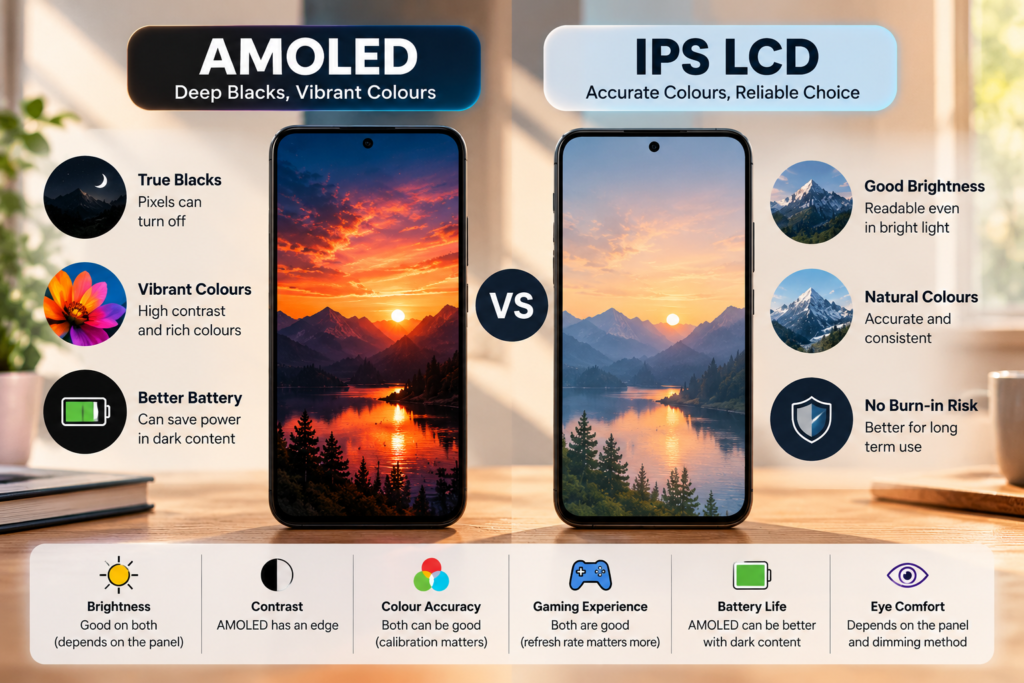
AMOLED vs IPS LCD: What Is the Difference?
The main difference between AMOLED and IPS LCD is how they produce images and light.
What Is an AMOLED Display?
AMOLED stands for Active Matrix Organic Light-Emitting Diode. Each pixel produces its own light, allowing individual pixels to be switched off when displaying black.
This pixel-level control gives AMOLED displays an advantage in contrast and black levels. It can also help manufacturers create thinner and flexible displays.
Common advantages of AMOLED displays include:
- Deep blacks and high contrast.
- Vibrant colours, depending on the display’s calibration.
- Good viewing angles on many panels.
- The potential to save power when displaying dark content.
- Fast pixel response on many implementations.
However, AMOLED displays can be more expensive to repair, and prolonged display of static elements can cause permanent burn-in over time.
What Is an IPS LCD Display?
IPS stands for In-Plane Switching. It is a type of LCD, or Liquid Crystal Display.
Unlike AMOLED, an IPS LCD does not produce light at each individual pixel. It uses a backlight that shines through liquid crystals and colour filters to create the image.
IPS technology generally offers good viewing angles compared with older LCD technologies. A well-made IPS LCD can display sharp text, accurate colours and sufficient brightness for everyday use.
Common advantages of IPS LCD displays include:
- Good image quality at a wide range of phone prices.
- No OLED-style permanent pixel burn-in.
- Good colour performance when properly calibrated.
- Potentially lower repair costs on some phone models.
The main limitation is that an LCD backlight remains active behind dark areas of the image. As a result, black areas usually look more grey than the blacks produced by AMOLED.
The actual quality of either display depends on the panel and the manufacturer’s implementation.
AMOLED vs IPS LCD: Quick Comparison
| Feature | AMOLED | IPS LCD |
|---|---|---|
| How it produces light | Individual pixels emit light | Uses a backlight |
| Black levels | Can produce true black by switching pixels off | Black areas usually appear lighter |
| Contrast | Generally higher | Generally lower |
| Colour appearance | Often vibrant; calibration matters | Can also deliver accurate colours |
| Viewing angles | Usually very good | Usually good |
| Battery consumption | Can benefit from dark content | Backlight uses power regardless of image content |
| Gaming | Excellent when paired with suitable refresh rate and hardware | Can also provide smooth gaming with suitable specifications |
| Burn-in | Possible after prolonged static content | Does not have the same OLED-style burn-in risk |
| Eye comfort | Depends partly on flicker and dimming behaviour | Also depends on the particular panel and dimming method |
| Phone cost | Often found in mid-range and premium models | Common in budget phones too |
This table describes general tendencies, not guaranteed results for every smartphone. A high-quality LCD can outperform a poorly implemented AMOLED panel in some areas, including brightness or colour accuracy.
AMOLED vs IPS LCD for Regular Use
For regular smartphone use, both AMOLED and IPS LCD can work well. Your choice depends on what you do most often.
WhatsApp, Instagram and Web Browsing
If you spend most of your time on WhatsApp, Instagram, Chrome and other everyday apps, either display can provide a good experience.
AMOLED can make dark interfaces look particularly attractive because black pixels can switch off completely. It can also make photos and videos appear more contrast-rich.
IPS LCD remains a practical option for everyday tasks. Text can look sharp, colours can be accurate and the screen can feel responsive when the phone has a good-quality panel.
For basic tasks, do not pay extra for AMOLED without checking the rest of the phone. A better processor, more storage or longer software support might matter more to you.
Watching YouTube, Movies and Reels
AMOLED generally has an advantage when watching content with dark scenes. Black areas can look genuinely black instead of appearing grey because individual pixels can turn off.
High contrast can make night scenes and dark backgrounds look more defined. However, the final image also depends on the content, brightness, colour settings and video quality.
An IPS LCD can still deliver an enjoyable video experience. If you mostly watch bright videos, news, sports or social media content, the difference might be less important than you expect.
Which is better for watching movies? AMOLED is usually the stronger choice when deep blacks and high contrast matter to you. A well-calibrated LCD remains a reasonable alternative, especially when the phone offers a better overall package for the price.
Reading and Long Browsing Sessions
Neither AMOLED nor IPS LCD is automatically more comfortable for every reader.
Text clarity depends on resolution, pixel density, font rendering and viewing distance. Low brightness, flicker characteristics and your personal sensitivity can also affect comfort.
If you frequently read at night, check whether the exact phone’s display flickers noticeably or causes discomfort at your normal brightness level. Some OLED displays use pulse-width modulation (PWM) to control brightness, and LCD displays can use different dimming methods too.
People can respond differently to these characteristics. A panel type alone cannot guarantee an eye-comfort advantage.
AMOLED vs IPS LCD for Gaming
If you play BGMI, Call of Duty: Mobile or other mobile games, AMOLED can deliver a visually impressive experience. However, choosing a display for gaming requires looking beyond the panel type.
1. Visual Quality and Dark Scenes
AMOLED’s high contrast can make dark scenes look deeper and colours appear more vivid. This can improve the presentation of games with detailed environments.
An IPS LCD can also show games clearly, particularly when the panel has good colour calibration and brightness.
The difference in visual quality does not automatically make one phone faster than the other.
2. Refresh Rate Matters
Refresh rate is measured in hertz (Hz). It describes how frequently the display can refresh its image.
For example, a 120Hz display can refresh up to 120 times per second when the phone and software allow that mode to operate.
A higher refresh rate can make compatible gameplay and scrolling look smoother. But a 120Hz display does not automatically mean a game will run at 120 frames per second (FPS).
The game must support the frame rate on that particular device, and the processor must be able to generate those frames consistently.
You can read our related guide: Does a 120Hz Display Mean 120 FPS in BGMI?.
3. Response Time and Touch Response
Response time describes how quickly a pixel changes from one state to another. Many OLED-based displays have very fast pixel transitions, which can help moving objects appear clearer.
Touch response is a different factor. Touch sampling rate describes how frequently the touchscreen checks for touch input, while actual input latency depends on several parts of the device and game.
A phone with an AMOLED display does not necessarily have better touch response than every IPS LCD phone.
For competitive gaming, compare the exact phone’s supported refresh rate, touch behaviour, chipset performance, frame-rate options and thermal performance.
4. Gaming Performance Depends on More Than the Screen
A fast display cannot compensate for a processor that struggles to maintain a stable frame rate.
When choosing a gaming phone, also consider:
- The chipset and its sustained performance.
- The maximum FPS officially available in your game.
- Heat management during longer sessions.
- Battery capacity and power consumption.
- The phone’s refresh rate and touch response.
Our verdict for gaming: AMOLED is a strong choice if you want high contrast and visually rich games, particularly when the phone also has a fast, well-implemented display. But a high-refresh-rate IPS LCD can still be an excellent gaming screen. Compare the entire phone, not just the display technology.
AMOLED vs IPS LCD: Which Is Better for Battery Life?
AMOLED displays can use less power when showing dark content because black pixels can switch off. This can make a difference when using dark mode or viewing content with large dark areas.
LCD displays rely on a backlight, so displaying a black image does not switch off the backlight in the same way.
However, the battery difference is not fixed. Screen brightness, refresh rate, display size, software, network usage and the content being displayed all affect power consumption.
For example, a bright, mostly white screen can change the relative power consumption of an AMOLED display. Meanwhile, the efficiency of the actual panel and its control electronics also matters.
Do not buy a phone based only on whether its display is AMOLED or LCD if battery life is your main concern. Check battery capacity, processor efficiency and reliable battery tests for the exact model.
Is AMOLED Better in Sunlight?
Not necessarily.
Outdoor readability depends on the display’s brightness, anti-reflective properties, automatic brightness behaviour and how well it remains readable under strong ambient light.
An AMOLED panel can offer excellent outdoor visibility, but the same is true of a sufficiently bright IPS LCD.
When comparing two phones, check their stated peak brightness carefully. Peak brightness may only be available in certain conditions, such as when displaying HDR content or when automatic brightness is enabled. It does not always represent the brightness available across the full screen for extended periods.
If you frequently use your phone outdoors, look for independent measurements and reviews of the exact phone rather than making a decision based on panel type alone.
AMOLED Burn-In vs IPS LCD: Which Lasts Longer?
One disadvantage associated with AMOLED displays is burn-in.
OLED pixels can age at different rates. If the same bright static elements remain visible for long periods, such as navigation elements or interface icons, a permanent unevenness in brightness or colour can develop over time.
Modern phones may use software and display-management techniques to reduce the risk. Burn-in is not inevitable, and its likelihood depends on usage and implementation.
IPS LCD does not have the same OLED-style permanent pixel burn-in mechanism. It may therefore appeal to people who want to keep a phone for many years and are particularly concerned about static interface elements.
That does not mean every LCD display will necessarily last longer than every AMOLED display. Overall durability also depends on glass protection, construction, heat, repair quality and general handling.
AMOLED vs IPS LCD: Which One Should You Choose?
The best display depends on how you use your phone.
| Your main priority | Which display should you consider? | Why |
|---|---|---|
| Watching movies and dark-scene content | AMOLED | Deeper blacks and stronger contrast |
| Playing games with rich visuals | AMOLED | Strong contrast and fast pixel response on many panels |
| Competitive gaming | Compare both | Refresh rate, game FPS support, touch response and sustained performance matter more than panel type alone |
| Everyday apps and browsing | Either | Both can deliver a good experience |
| Keeping the phone affordable | IPS LCD may be suitable | Can provide good quality while leaving room in the budget for other hardware |
| Reading at low brightness | Compare the exact models | Flicker behaviour and personal sensitivity matter |
| Avoiding OLED-style burn-in concerns | IPS LCD | Does not have the same OLED burn-in risk |
| Using the phone outdoors | Compare brightness measurements | Panel type alone does not determine sunlight readability |
Final Verdict: AMOLED or IPS LCD?
For most buyers who prioritise deep blacks, high contrast and a premium-looking picture, AMOLED is an attractive choice. It can be especially enjoyable for movies, photos and dark-scene gaming.
IPS LCD is still worth considering if the particular phone offers good brightness, a suitable refresh rate and strong overall value. A good LCD phone can be a better purchase than an AMOLED phone with weaker performance or other important compromises.
If gaming is your main priority, compare the phone’s chipset, supported FPS, refresh rate, touch response and cooling. If regular use is your priority, pay attention to readability, brightness, colours and battery performance.
The bottom line: AMOLED is often the better choice for contrast and black levels, but it is not automatically the best display for every person or every phone. Compare the complete specifications and the quality of the specific panel before deciding.
Frequently Asked Questions
Is AMOLED better than IPS LCD?
AMOLED generally offers deeper blacks and higher contrast because individual pixels can turn off. IPS LCD can still provide good image quality, brightness and colour accuracy. The better option depends on the particular phone and your priorities.
Which is better for gaming, AMOLED or IPS LCD?
AMOLED can provide strong contrast and fast pixel transitions, but gaming smoothness depends on refresh rate, supported FPS, chipset, touch response and thermal performance. A well-implemented IPS LCD can also be suitable for gaming.
Which display is better for daily use?
Both are suitable for everyday use. AMOLED is appealing for contrast and dark-mode interfaces, while IPS LCD can be a practical choice at a lower phone price. Compare brightness, readability, battery behaviour and the rest of the phone.
Does AMOLED save more battery than IPS LCD?
AMOLED can consume less power when displaying dark content because black pixels can switch off. Actual power consumption depends on brightness, content, refresh rate and the specific display implementation.
Is IPS LCD safer for the eyes than AMOLED?
There is no universal answer. Eye comfort can depend on flicker and dimming behaviour, brightness, viewing conditions and individual sensitivity. Some OLED and LCD displays use different PWM or other dimming methods, so check the exact phone if you are sensitive to flicker.
Can AMOLED displays get burn-in?
Yes. Prolonged display of the same static elements can cause permanent burn-in on OLED-based displays. Modern mitigation features can reduce the risk, but they cannot make it impossible.
Is a 120Hz IPS LCD better than a 60Hz AMOLED for gaming?
A 120Hz IPS LCD can offer smoother motion than a 60Hz AMOLED display when the phone, game and active display mode support the higher refresh rate. However, refresh rate alone does not determine the complete gaming experience.